This article is part of the One(s and Zeros) to Grow On series, where I share valuable legacy application modernization lessons from nearly 30 years in technology about leadership, software architecture, communication, creativity, and the people behind the code. Explore the full series.
For years, I kept an aging application alive through a combination of upgrades, patches, workarounds, and a healthy amount of stubbornness. Eventually I reached a point every technology leader, architect, and developer faces.
I still wanted it to continue working and being updated. But the technology underneath it had reached the end of the road. I could rebuild it. Or I could retire it forever. That was exactly where I found myself.
I had an application that was built on CodeIgniter 1.7.3, a framework that served me extremely well for many years. Over time, I continued updating and maintaining it, even as PHP evolved around it, and honestly, beyond it.
When new versions of PHP were released, I found ways to adapt to them. When compatibility issues appeared, I worked around them. When the framework showed its age, I used my skills to artificially extend its lifespan. But an inevitable reality finally set in. The technology stack it depended on had reached end-of-life and there was no realistic path forward.
And that realization taught me some valuable legacy application modernization lessons , technical debt, and what it really takes to evolve software over time.
Legacy Systems Usually Don’t Fail All At Once
A truth I’ve learned over the years is that most legacy systems don’t die because they suddenly stop working.
They usually end up dying around the edges.
A framework reaches end-of-life. Libraries stop receiving updates. Documentation becomes harder to find. Security concerns grow. New developers are unfamiliar with the technology. Eventually, the ecosystem that once supported the application starts disappearing.
In my case, I made compatibility fixes and workarounds that allowed the platform to continue operating long after the environment around it had changed. And that strategy actually worked well for a long time.
But when PHP 8 arrived, the reality became clear.
No amount of effort to continue patching and adapting the legacy codebase was going to work anymore. It had truly reached the end. I would have to rebuild it or close the door on it forever.
After investing years into the platform, that wasn’t an easy conclusion to accept.
Modernization Starts Long Before the Rewrite

One misconception I often see is the belief that modernization begins when developers start writing new code. In my experience, it starts much earlier.
Years before rebuilding the application, I was already investing time in learning modern development practices. I took training courses, experimented with newer frameworks, explored different architectural approaches, experimented with tools like Node.js, and spent time understanding how the PHP ecosystem was continuing to grow and evolve.
The goal wasn’t to rebuild anything immediately. The goal was preparation. Looking back, this may have been the most important decision of the entire project.
Technology changes quickly. Frameworks evolve. Development practices improve. One of the most valuable skills any developer can develop is the ability to learn before they’re forced to.
By the time I committed to rebuilding the application, I wasn’t starting from scratch. I had already spent considerable time building the foundation of knowledge needed to make informed decisions.
The time I spent doing this preparation turned out to be invaluable later.
Investing in Learning Reduces Future Risk
Learning isn’t something you do after a modernization project starts.
It’s something you do continuously.
The organizations and developers who adapt most successfully are usually the ones who never stop learning in the first place.
Modernization becomes far less intimidating when you’ve already spent time exploring the technologies that will eventually replace what you’re using today.
The Proof of Concept That Changed Everything
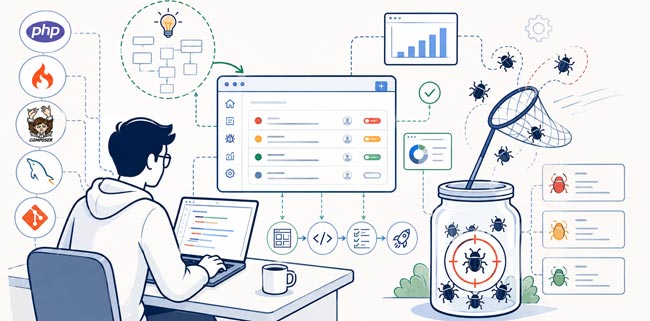
Before writing my first line of the new application, I wanted proof that my assumptions were correct. Instead of attempting a full migration immediately, I chose a smaller project.
A bug tracking application that supported the original platform became my test case. Rather than attempting to upgrade the old application, I rebuilt it entirely using CodeIgniter 4.
The project wasn’t large, but it was large enough to answer important questions.
- Could I be productive in the new framework?
- Would the architectural patterns make sense?
- Would the development experience improve?
- Would the effort be worth it?
The answer to all four questions was yes. The proof of concept ended up being a complete success. The framework clicked almost immediately, and for the first time in years I found myself genuinely excited about building in CodeIgniter again.
More importantly, it gave me confidence that the larger modernization effort was achievable. That’s a lesson I think applies far beyond software development.
Large transformation projects shouldn’t begin with assumptions. They should begin with fact based evidence.
Learning CodeIgniter 4 Was Really Learning a New Philosophy
What surprised me most wasn’t just how much the CodeIgniter framework had changed even since the 3.x version. It was how much modern PHP development had changed. The differences went far beyond syntax.
- Composer had transformed dependency management in PHP much the same way NPM transformed the JavaScript ecosystem.
- Namespaces had become standard practice.
- Models, entities, services, commands, and traits introduced cleaner architectural patterns.
The framework encouraged a level of structure and separation of concerns that simply wasn’t possible when CodeIgniter 1.7.3 was originally released. Luckily, these concepts felt familiar thanks to my lengthy experience with MVC design patterns.
But the deeper I went, the more I realized that modern frameworks aren’t necessarily about making development more complicated. They’re about making large applications cleaner, better organized, and more maintainable. Common functionality was being abstracted in a common shared library.
What surprised me most wasn’t that these patterns were new.
It was that many of them had become industry standards while I was busy keeping a legacy application alive.
The framework wasn’t just giving me new tools. It was encouraging me to think differently about application design.
And that shift in thinking turned out to be more valuable than any individual feature.
The Hardest Part Wasn’t Technical
Looking back, the most difficult part of the modernization effort wasn’t learning a new framework. It was challenging old outdated patterns and technical assumptions.
When you’ve lived with an application for so many years, you naturally start accepting certain workflows, designs, and limitations as normal.
You stop asking why things work the way they do. You start designing around limitations instead of questioning whether those limitations should still exist.
Modernization forces those questions back into the conversation.
- Why does this process exist?
- Would we build it this way today?
- What problem were we solving originally?
- Is that still the right solution?
Some features remained because they still made sense. Others were redesigned entirely. A few weren’t needed anymore and were removed entirely.
The process wasn’t about recreating the past. It was about deciding what the future should look like.
That’s when I realized something important:
Modernization isn’t about rebuilding yesterday’s application.
It’s about creating tomorrow’s application.
Rebuilding Opened Doors That Didn’t Exist Before
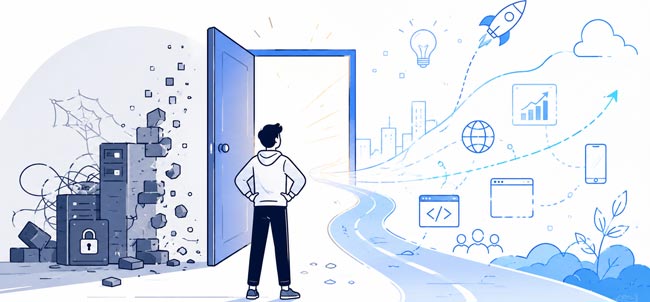
One unexpected benefit of modernization was the opportunity to think much bigger about architecture.
The legacy application had evolved over many years, and like most long-running systems, it reflected the realities and constraints of the time it was originally built.
Starting fresh created opportunities that simply weren’t practical before.
The resulting architecture is significantly more flexible, easier to maintain, and capable of supporting multiple websites and applications from a shared foundation.
Years ago, I would never have attempted to build multiple websites and applications from a shared codebase. The architecture simply wasn’t designed for it.
Modernization didn’t just solve an old problem. It created entirely new possibilities that old technology prevented.
Sometimes the greatest value isn’t what you rebuild. It’s what becomes possible afterward.
What This Experience Reinforced About Technology Leadership
While this project started as a technical challenge, it ultimately reinforced several broader lessons.
First, adaptability matters more than familiarity.
Technology will continue changing throughout our careers. The frameworks we use today will eventually be replaced by something else. The developers who thrive are the ones willing to evolve alongside the industry.
Second, principles outlive technologies.
Frameworks change. Languages evolve. Architectural trends come and go. Fundamental problem-solving skills remain valuable regardless of the technology stack.
Finally, modernization is rarely just a technical exercise.
It’s simultaneously a business decision, a risk management decision, and an investment decision. Organizations aren’t simply upgrading software; they’re deciding how they want to operate in the future.
And sometimes it’s a decision about positioning yourself for the future rather than remaining anchored to the past.
What I Would Do Differently
If I had to take on another full modernization effort tomorrow, there are a few things I’d do differently.
First, I’d start learning earlier. Looking back, every hour I spent exploring modern development practices before the rebuild paid dividends later. The sooner you begin investing in the future, the less intimidating that future becomes.
Second, I’d build the proof of concept sooner. That small bug tracking application answered questions that months of planning and research couldn’t. Once I had something working in the new framework, uncertainty started disappearing.
Finally, I’d challenge old assumptions faster. Some of the biggest improvements didn’t come from new technology. They came from questioning workflows and design decisions I had accepted for years simply because “that’s how we’d always done it.”
Final Thoughts
Every organization eventually encounters a modernization crossroads. It might be a framework upgrade, a cloud migration, or a complete platform rebuild. The technologies involved will differ, but the underlying challenge remains remarkably similar.
How do you preserve the value of what you’ve built while creating space for what’s next?
For me, moving from CodeIgniter 1.7.3 to CodeIgniter 4.7 wasn’t simply a framework upgrade. It was an opportunity to rethink old assumptions, modernize to modern best practices, strengthen the architecture, create a modern mobile first experience, and prove that continuous learning remains one of the most valuable skills in technology.
- The code changed.
- The framework changed.
- The architecture changed.
Looking back, I don’t think the biggest lesson had anything to do with CodeIgniter or PHP.
Ten years from now, there will be another framework, another language, and another set of tools everyone is excited about.
What won’t change is the need to learn continuously, question old assumptions, and adapt with the industry.
That’s the real skill we should all be investing in.
Join the Conversation
Every developer eventually inherits a piece of software that was built for a different era.
What modernization project has taught you the most?
Was it a framework migration? A cloud transformation? A complete rewrite? Or did you find a way to extend the life of a system everyone else had written off?
I’d love to hear your story. Share it in the comments or connect with me on LinkedIn or Reddit. Some of the best lessons in technology don’t come from documentation—they come from the people who’ve lived through them.
And join us for more great articles as we build on One(s and Zeros) to Grown on, One one and zero at a time!
