
This 3-part series documents the full journey from retiring an aging legacy setup to rebuilding on modern cloud infrastructure and finally launching the new live sites.
Start from the beginning or jump to any part.
- Part 1: Letting Go of Legacy Systems and Old Sites
- Part 2: Rebuilding the Stack on Modern Cloud Infrastructure
- Part 3: Launching the New Ecosystem: What’s Live Now
Welcome back to the series!
In Part 1, I talked about how I shut down an aging set of personal Web sites on a legacy server.
In Part 2, I walked through the process of rebuilding everything on a modern cloud hosting platform (including cloud hosting, a modern LAMP stack, and updated deployment workflows).
Here now in Part 3 is where it all comes full circle. Here is where we talk about what is LIVE today!
From Reset to Relaunch
There’s a moment in any rebuild where things stop being theoretical.
- The environments are ready.
- The code is stable.
- The structure finally makes sense.
- The tools are in place—and finally working.
And then comes the real question every developer always comes to:
Is it ready to go “live”?
For me, that answer wasn’t about perfection—though I certainly wanted things to be READY.
These sites didn’t need to be “finished”—because honestly, what site ever is?
They needed to be modern, stable, secure and ready to grow if and when needed.
So after a lot of elbow grease, lots of command line sessions, a lot of testing and finishing touches, I made everything LIVE!

A Simpler, More Focused Web Presence
One of the biggest changes from the old setup is what’s not here anymore.
Gone are:
- Scattered legacy projects
- Outdated experiments
- Sites that no longer had a purpose
- Things lingering in the back of my mind making me think, “Is this safe?”
What’s left is a much more intentional ecosystem—each site serving a clear purpose and role, both technically and creatively. The goal was:
- Shed expired code with potential security and performance issues
- Remove unnecessary frameworks and libraries that could become outdated or hard to maintain
- Remove sites that no longer made sense
- Reduce the clutter and issues.
- Focus on the relevant and important.
Here’s a look at the current live ecosystem—each site with a defined role, purpose, and direction.

SimLeaguesPro – Online Sports League Simulation Platform
SimLeaguesPro is the online sports sim league site that sits on top of games like OOTP, combining community, management, discovery, and intelligence into one platform.
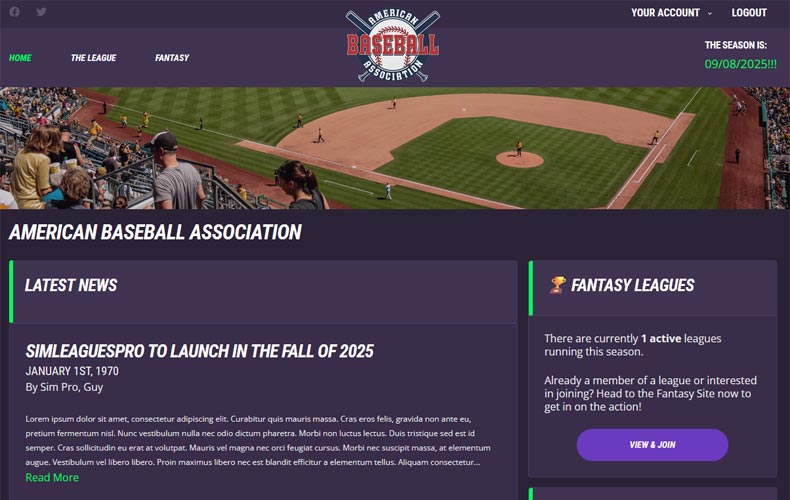
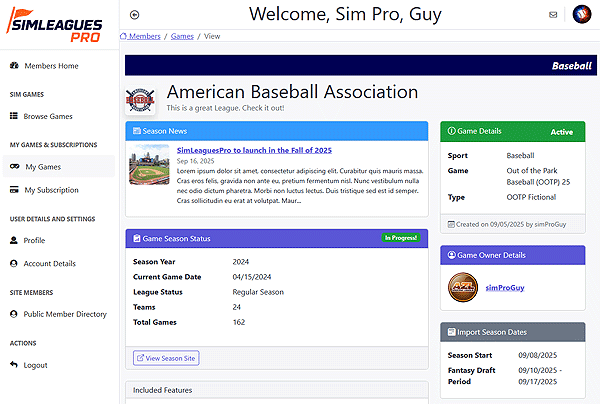
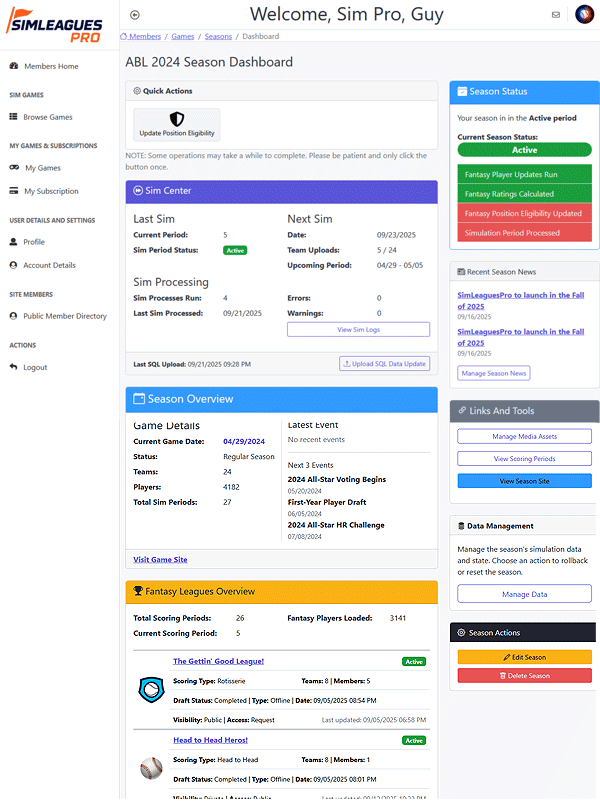
Built specifically for games like Out of the Park Baseball (OOTP), but designed to expand beyond a single game, this is the crown jewel of the new platform.
Built brand new from the ground up, it’s designed to:
- Support online OOTP (and eventually other sport sim) leagues
- Provide centralized league member management and communication
- Handle displaying game data and providing access to league member downloads
- Enable year-round Fantasy sports play based on these leagues
This has been over a year in development and represents the largest technical project I’ve ever taken on (second only to it’s predecessor, the OOTP Fantasy leagues mod). It’s been a long and time consuming journey, but in hindsight, one I’m glad I took on.
It alone forced me to evaluate my old platform, research and select a new modern cloud host, and update and expand my skills to meet the numerous technical challenge building the site posed.
I’d love to go into more here, but honestly, due to the scale and sheer laundry list of features available, it truly deserves—and will get—its own deep dive series into it’s development and features.
So stay tuned for future looks into this exciting modern take on OOTP Online league platform and a bold new evolution of Fantasy sports online!
Foul Territory – Baseball Cartoon Blog
https://www.foulterritorycomic.com
A baseball-themed web-comic focused on humor, satire, and quick-hitting visual storytelling.
It’s intentionally simple—fast loading, mobile-friendly, and focused entirely on the cartoons. This project reminded me that not every site needs a heavy framework or deep architecture. Sometimes you just need a place to create and share.
Created as a homage to the great single panel Newspaper gag comics that I grew up with, Foul Territory completely unleashes all my own inner comedic absurdities and love of the game into one focused and easy to browse site.
With SimLeaguesPro leaving its heavy development stage, I will likely have more time to devote to creating and publishing great cartoons on this site! I hope you’ll enjoy following along and reading as well.
The jfox015.com family of sites – Professional, Personal (and fun)

jfox015.com – Personal Tech Blog & Development Journal
A personal blog covering software development, cloud architecture, and technical know-how.
This blog is relatively the same though it has been cleaned up with:
- Outdated posts removed
- Content refreshed
- Dead or irrelevant links removed or updated
Going forward, this is where I’ll be writing about:
- My SimLeaguesPro (and other) development experiences
- Doing technical deep dives
- Posting project and content updates
- Sharing important skill lessons learned
- Posting updates to other sites like Foul Territory.
This very series is the kick-off to a renewed publishing effort and there will be more to come!

Jfox015 Consulting – Technical Services & Architecture
https://consulting.jfox015.com
A simple single-page site focused on:
- My technical background
- Areas of expertise
- Consulting services
It’s intentionally simple—clear, direct, and easy to browse. It contains different areas of expertise and a form to reach out about my services.
Need a web site. Technical help? Help setting up an email campaign? Social media setup or support? Help with Microsoft Office 365 or Outlook? Or help with AI? This is the place to reach out to connect with me to see if I can help.

The Adventures of Spud – Comic Archive
A refreshed version of the site that showcases my original published comic book, The Adventures of Spud!
It details the entire journey through an online comic book contest including the pitch, characters, marketing efforts, and different rounds of community voting that ultimately led to it being selected for publishing.
I created the original version of the site while the artist Mark Oakley and I were competing in the Small Press Idol comic book contest. I contemplated retiring it as it was woefully outdated, but seeing how it chronicled and a very important achievement in getting a comic book pitched and printed, it still had enough value for me to warrant an update.
The refresh therefore focused on:
- A modern mobile-first UI design
- Refreshed presentation of content
- Updating the site to act as a record of the project, not as if it was still in progress
It’s a small simple site—but an important one to me so I’m glad for the refresh and to have it ready for people to browse and learn about the comic once more.

JFOX Music – Original Music & Performances
Apart from my band and collaborative music efforts, this site is focused on my own personal music writing and performing efforts.
It features:
- My music focused bio
- Demo tracks of original music recordings
- Links to performances and social channels
Like Foul Territory, it’s more about expression than complexity. It received small updates to bring it up to the same standard as all the rest of the sites.
What’s Different This Time
This isn’t just a new and updated set of sites. It’s a completely different approach.
Everything is now built around:
- Mobile-first design – Every site is optimized for modern devices
- Security – Minimal forms, all hardened against modern threats
- Simplicity – No unnecessary frameworks or legacy code
- Maintainability – Reduced dependencies and streamlined stack
- Scalability – Built to grow without re-architecture
- Clarity of purpose – Every site exists for a reason
There’s no extra weight. No legacy baggage. No “just keep it running” mentality. Each site exists because I want it to exist—not because it always has.

Launching Isn’t the Finish Line
If there’s one thing I’ve learned through all of this, it’s that launching isn’t the end. It’s really the starting point. This blog series is proof of that. Once the sites are built, you then have to do the work of announcing, promoting, and driving traffic through SEO, social media, and content strategy. Traffic doesn’t just manifest itself—you have to actively build it.
These sites will likely continue to evolve and change. Some may grow. Some will eventually come down or be replaced with newer versions. So is the way of technology and the web.
But right now, they’re built in a way that allows that to happen without having to completely start over again.
What Comes Next
With everything now live, the focus shifts from rebuilding to growing.
Future posts in this series (and beyond) will dive deeper into:
- What motivated me to finally dive into a complete rewrite of the OOTP Fantasy Leagues mod into SimLeaguesPro
- Lessons learned from modernizing to a cloud platform
- Tips and lessons learned from using AI tools in real-world development workflows
- Building and maintaining creative outlets alongside technical platforms
Final Thoughts
The last year plus certainly has been an eye opening and interesting journey. After years of working at the architecture level and not being regularly “hands on” in the code or application layers for a very long time, it was both exciting and time-consuming diving all the way back down to the command line level to get everything that needed to be archived taken down and the new environment fully stood up.
Launching and going live has been a relief. A hard earned milestone achieved. And the beginning of the next step. Getting these out to the masses to see and USE them!
Because for the first time in a long time, everything feels aligned—technically, creatively, and personally.
And more importantly, this time, its built in a way that won’t require tearing everything down again in a year.
This 3-part series has really been about more than just rebuilding websites. It’s been about reassessing what matters, letting go of what doesn’t, and building something sustainable moving forward.
If you’ve ever gone through a full rebuild of your own projects—what did you keep, and what did you leave behind?
I’d genuinely love to hear how others approached it—especially what was hardest to let go of.
Thank you for reading!
If you’re just joining the series here in Part 3, I suggest going back and reading the earlier parts to get the full context of the rebuild:
Part 1 – Letting Go of Legacy Systems and Old Sites
Part 2 – Rebuilding the Stack on Modern Cloud Infrastructure
